
Culture Starts Here, Ep7: What we learned from CultureCon [podcast video]
A special episode of Culture Starts Here, recorded live at CultureCon 2025 in Madison, Wisconsin
ADVISA CEO Heather Haas and Leadership Consultant BJ McKay recorded a live episode of Culture Starts Here – capturing what today’s culture leaders are seeing throughout a variety of diverse industries. Across sessions, panels, and conversations, one takeaway was clear – the marketplace is converging around the same five drivers ADVISA champions through our ATLAS framework.
- Executive teams must activate culture from the top.
- Trust and shared purpose must be intentionally built.
- Leaders must be equipped to carry culture through daily behavior.
- People data must inform decisions.
- And systems must reinforce – not contradict – stated values.
The pressures organizations face today – AI acceleration, generational shifts, burnout, retention volatility – are not abstract trends. They are operational realities. And they require a disciplined, leader-led approach to culture.
What we heard at CultureCon didn’t challenge ADVISA’s point of view.
It affirmed it.
Episode 7 highlights
Highlights and practical insights you can apply within your own organization:
Why culture still starts at the top
One of the strongest themes from CultureCon was clear – culture activation begins with executive alignment.
Before engagement surveys.
Before learning programs.
Before values refreshes.
Executive teams must align on what culture means and whether they are willing to prioritize it with time, attention, and budget.
This is ADVISA’s first ATLAS driver – Activation from Above. When CEOs partner closely with HR leaders and put real investment behind culture initiatives, the organization follows. When they do not, culture efforts stall.
If the executive team is not aligned from the beginning, culture work becomes reactive instead of strategic.
Culture evolves when leaders listen
A quote that stood out during the event: Cultures that listen are cultures that evolve.
Listening is not agreement. Empathy is not endorsement.
But creating structured ways for employees to be heard – listening sessions, people data, coaching conversations – builds trust. It also allows organizations to adapt as workforce expectations shift.
This directly connects to ATLAS drivers two and four – Trust and Shared Purpose and Actionable People Data.
Without listening, culture becomes static. With listening, culture becomes responsive.
Learning must be baked in – not sprinkled on
Another powerful takeaway – learning and development must embed your values, not merely reference them.
High-performing organizations are:
- Integrating values into hiring and interview rubrics
- Role-playing real value-based scenarios during interviews
- Evaluating performance against cultural behaviors
- Embedding strategic imperatives into leadership development
When values are “sprinkled on,” they fade.
When values are baked into hiring, development, and performance management, they shape daily decisions.
This reflects the ATLAS driver of Systems That Support Leaders – your policies, processes, and programs either reinforce your culture or quietly undermine it.
Mindset precedes behavior
Several speakers emphasized that mindset is the gateway to change.
You can design the best leadership program in the world. But if participants lack curiosity, adaptability, and a growth orientation, behavior change stalls.
Mindset dictates what behaviors follow.
This is especially critical as AI reshapes work. As one speaker framed it – AI is an amplifier. The human advantage becomes creativity, connectivity, agility, and emotional intelligence.
Organizations that hire and develop for growth mindset will adapt faster.
Resilience is about recharge – not endurance
A refreshing reframe from the event: Resilience is how you recharge, not how you endure.
High-performing cultures do not simply push people to tolerate stress longer. They build systems that allow for renewal.
A brain-friendly break requires:
- Letting something out of your body
- Limiting information coming in
In a world of constant input, sustainable performance requires intentional recovery.
For leaders, even modeling burnout awareness and acknowledging team fatigue can be powerful.
The future workforce expects more
By 2030, the workforce will be predominantly millennial and Gen Z.
These generations are:
- Highly educated
- Highly diverse
- Purpose-driven
- Less tolerant of command-and-control leadership
Emotional intelligence and relational leadership are no longer “nice to have.” They are strategic capabilities.
Organizations that ignore this shift will struggle with attraction and retention. Organizations that adapt will build loyalty and engagement.
Emotional intelligence and relational leadership are no longer “nice to have.” They are strategic capabilities.
Culture lives in conversations
Perhaps the simplest – and most profound – insight: Culture lives in our conversations.
What leaders celebrate.
What they tolerate.
What they say in meetings.
What they say when things go wrong.
Culture is not built by memos. It is built in micro-moments.
When employees begin using the organization’s values language unprompted, trust begins to solidify. When leaders consistently align words with actions, culture becomes credible.
Key takeaways for leaders
- Align your executive team first. Define what engagement and culture mean to you.
- Create structured listening mechanisms. Listening sessions, pulse surveys, coaching touchpoints.
- Bake values into systems. Hiring, development, performance management.
- Hire and develop for mindset. Prioritize curiosity, agility, and emotional intelligence.
- Model resilience through renewal. Normalize recovery, not just endurance.
- Audit your conversations. What language dominates your meetings? Fear or growth? Blame or ownership?
Culture work is not a quick fix. Research suggests meaningful culture change takes three to five years. But when done intentionally, it becomes a competitive advantage.
Want to assess your culture?
If you would like a starting point, ADVISA offers a free Culture Check assessment. In five minutes, you will receive a snapshot of strengths and opportunities across the five drivers:
- Activation from Above
- Trust and Shared Purpose
- Leader Effectiveness
- Actionable People Data
- Systems That Support Leaders
It is a practical way to turn a complex topic into a focused conversation.
About Culture Starts Here
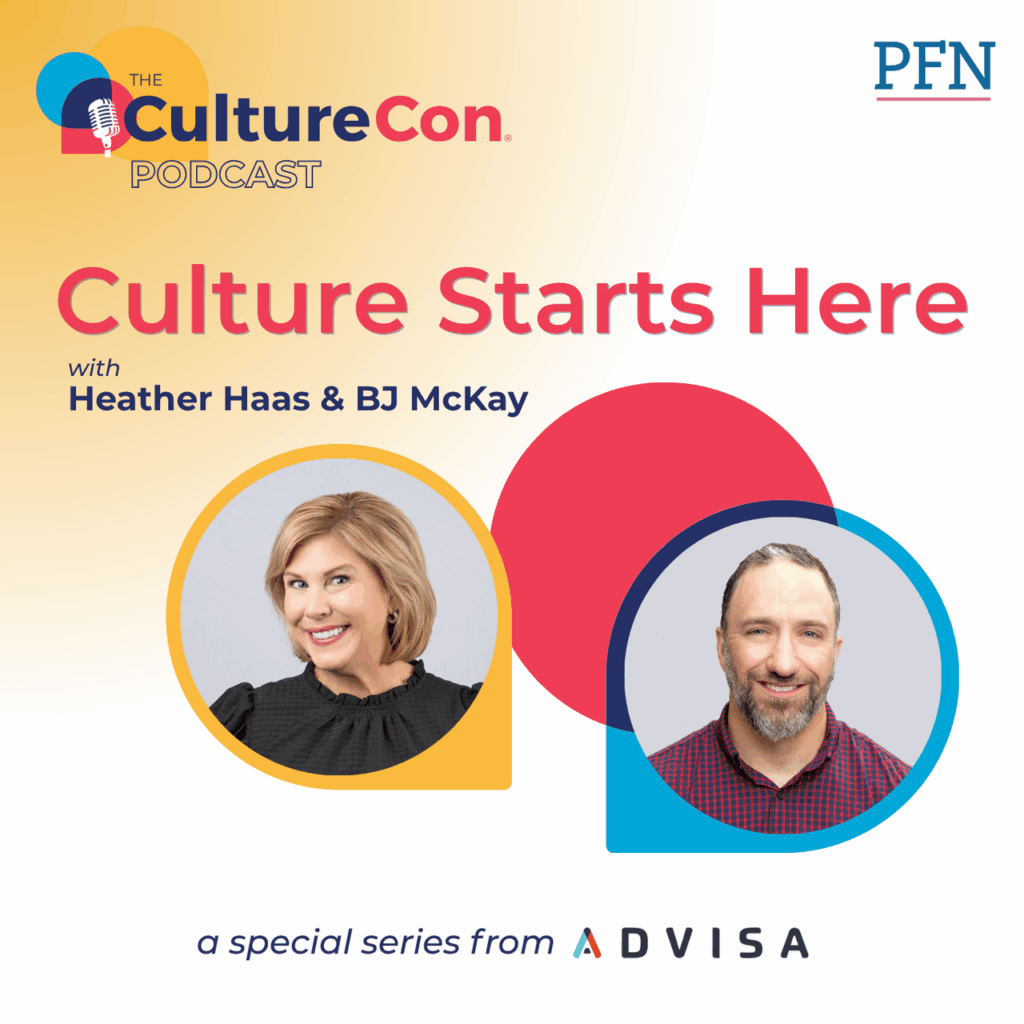
Culture can be an organization’s biggest threat to growth – or its greatest opportunity for competitive advantage.
In Culture Starts Here, a special series on the CultureCon podcast, ADVISA CEO Heather Haas and leadership consultant BJ McKay share insights and tactics you can use to jump-start your organization’s optimal culture. This and every episode of Culture Starts Here includes the answer to the most common question ADVISA’s leadership consultants hear: Where do we start?
All episodes
- Culture Starts Here, Ep1: Meet ATLAS
- Culture Starts Here, Ep2: One thing your C-Suite absolutely can’t delegate
- Culture Starts Here, Ep3: Do Mission, Vision, and Values Really Matter?
- Culture Starts Here, Ep4: Do Your Leaders Know What to Say and Do To Be Effective?
- Culture Starts Here, Ep5: For Leaders, This Can Make the Difference Between a Guess or a Smart Decision
- Culture Starts Here, Ep6: Leaders Are Only as Effective as the Systems That Support Them
- Culture Starts Here, Ep7: What we learned from attending CultureCon
RELATED RESOURCES
ADVISA
- Get your free 5-minute Culture Check!
- How ADVISA’s process creates thriving leader-led cultures
- Connect with Heather on LinkedIn
- Connect with BJ on LinkedIn
CultureCon
PeopleForward Network
- Other podcasts from PeopleForward Network, the producers of The CultureCon Podcast and Culture Starts Here