
What if everybody did that… in the workplace?
It’s one of my favorite children’s books.
On average, as adults, we make 35,000 choices per day. Many of them pass without a thought or feel too small to matter. One of my favorite children’s books, What If Everybody Did That?, paints the picture for us: a small choice becomes a mess, and the mess becomes the landscape we share.
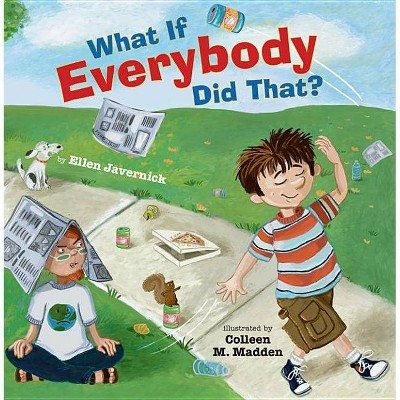
Work isn’t so different.
On impulse or out of habit, leaders make small assumptions: They’ll figure it out. They already know what to do. We’ll talk about it later.
Any one of those is a blip. Multiply it across a leadership team or a department, and it stops being a management habit. It becomes the culture. What goes unsaid is how the work is actually expected to get done.
The “what” is written down. The “how” is not.
Job descriptions say what a role does but doesn’t answer the question critical for success: how is the work expected to get done here?
There are several ways to do the same job. One sales leader builds pipeline over coffee and long relationships; another builds it on volume and speed. Neither is wrong. But inside a given team, one is usually celebrated, and the other is tolerated, or not.
That expectation is real even when no one says it, and it gets louder over time. You can see it in who gets praised, who gets promoted, and who is labeled “not a fit.”
The problem: expectations that exist without being said, written, modeled and celebrated.
When one manager leaves the how unspoken, one employee guesses. When it’s the norm, the guesses harden into rules. Instead of asking, “What if everybody did that?” people start saying, “Everybody else does it.”
This old warning comes with a real price.
None of this is new.
In the 1890s, French sociologist Émile Durkheim gave the term anomie its modern meaning: normlessness, what happens when people can’t tell what’s expected, what’s enough or what counts as success.
Organizational researchers later called it role ambiguity.
In 1964, Robert Kahn and colleagues at the University of Michigan found ambiguity tracked with tension, lower satisfaction and eroding trust in leaders. Meta-analyses since have found that, among common workplace stressors, it ranks with the strongest predictors of lower performance.
More than sixty years later, that data still tracks.
According to Gallup, 56% of U.S. employees strongly agreed they knew what was expected of them at work in 2020. By late 2024, it was under half. Isn’t that fascinating considering the uncertainty and ambiguity of 2020?
Still, executives are built for momentum. The instinct says go. Post the role. Fill the seat. “I just want to hire someone who already knows.”
Knows what, though? The candidate who thrived at their last company learned that company’s unspoken rules. They arrive fluent in a dialect your team doesn’t speak.
Slowing down to define the how feels like a delay. But skipping it has costs of its own: the review that surprises, the improvement plan that feels one-sided, and eventually the resignation. Gallup puts the cost of replacing an employee at half to twice their annual salary, and 52% of people who quit say their manager or organization could have done something to keep them.
The hours and energy get spent either way. Stopping a leadership team to ask, “What does great look like in this role, here?” is uncomfortable when the calendar says hurry. It can’t be delegated to a template.
What if everybody did this?
Turn the book’s question around. What if a leadership team spoke the how out loud before the next hire, the next review, the next reorg?
Start small:
- Run a gap check. Ask each of your direct reports to write down the three things they believe they’re measured on. Write your own list for each of them. Compare, and talk about what was previously unspoken.
- Define before you post. Before the next hiring req goes out, get the leaders who touch the role in one room to agree on its critical behaviors, not just its tasks. If they can’t agree in the room, the new hire won’t figure it out on their own.
- Audit your surprises. After the next review cycle, ask how many people heard something for the first time. Each surprise marks an unspoken expectation.
Clarity for one person helps. Clarity as a habit across a leadership team changes the culture and gives back the hours spent cleaning up after its absence.
The book asks its question as a warning. Leaders get to ask it as an invitation.

Now, what about your workplace?
Every organization has its own culture challenges, and sometimes a fresh perspective can make all the difference.
Have something on your mind? Let’s talk it through.