
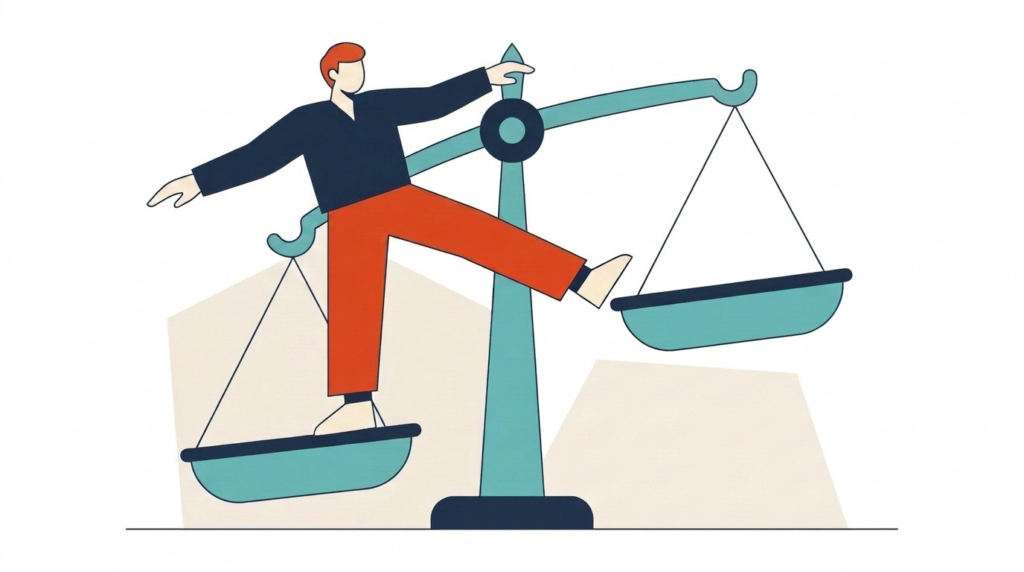
Can we please stop saying “work-life balance”?
The myth behind balance is evident in its semantics, suggesting that work and life are things we could ever parse apart. It implies a magical equilibrium that would set us free. I can’t leave my hand in the car when I arrive at the office any more than I can leave my values, my experiences or my worries. There is only … life.
In the present day, work-life balance isn’t working. Women are still burning out in disproportionately higher numbers than men — roughly 60% of senior women, the highest percentage in five years.
And yet we’re sold the illusion that stacking eight nice and neat hours over here and eight over there will surely bring us some peace. I’ll bet you’ve lived the counterevidence: home by 6, weekend protected and felt hollowed out. Or perhaps you’ve had weeks that are objectively off-balance and you felt inexplicably alive.
Balance is mythical because we’ve linked it to time.
We optimize what we can measure. For decades, measuring balance has been about hacking time, which is like telling someone to juggle water.
Time is elastic. It stretches to accommodate what we deem important. When I say, “I don’t have time,” what I mean is, “That’s not a priority for me.” Has your hot water heater ever flooded your basement? It probably cost you a dozen hours of remedial work that you found a way to do. Had I asked you before the flood if you had 12 hours to train for a race with me, you’d probably tell me to buzz off.
The more accurate measurement for equilibrium isn’t time — it’s our emotional gas tank. Emotions are involuntary neurobiological responses that happen spontaneously with a beginning, a middle and an end. Think tunnels, not caves. Emotions are also data. And they’re the data you should optimize to determine whether you feel any sense of equilibrium.
Tragically, the average human can name a whopping three emotions — happy, mad, sad — yet neuroscience confirms we’re indeed “feeling creatures who think.”
When Herbert Freudenberger coined the term “burnout” in 1975, his discovery was profound: Emotional exhaustion is at its center. We are exhausted because we are stuck in a chronic energy-stealing feeling.
Women contribute an average of 200 more hours of non-promotable work annually than men. That’s a month of work. Women are also 48% more likely to volunteer for tasks that no one else wants.
When I coach leaders asking for support with “work-life balance,” they reach for time management strategies. But before we reorganize the container, women must do the deeply personal work of knowing what they want. Very few do. Only 7% of the population knows their values at all.
In all our attempts to save time by making right turns only and sending our laundry out, it’s the self that continues to be the most terrifying cave we dare to enter. “People will do anything — no matter how absurd — to avoid facing their own souls,” Carl Jung said.
Are you clear on these three aspects about yourself?
If you’re aiming to reclaim your energy and sense of purpose, here are three things you must know about yourself:
Values. These are your energy GPS. Values are not virtues (honesty!) or wishes (happiness!) or personality traits (proactivity!). If it has a moral center, it’s not a value. Most of you will nod in agreement that being kind is a good thing. That makes kindness a virtue, not a value, for example. Values are morally neutral to everyone but you. Make them usable and not junk.
Aptitudes. Aptitudes aren’t your skills or experiences; they are your intellectual and emotional hardwiring. What feels easy to you that’s hard for everyone else? We can want a certain life, but your aptitudes tell you if that life is yours to live.
Economically viable interests. What pulls at your curiosity that can also pay you? There are 135 industries in our present economy, and about a dozen industries of the future. Most of us know five. Open your aperture to possibilities that pull you in.
Suzy Welch, a professor of management practice at NYU Stern School of Business, will not sugarcoat the reality that “becoming you” takes time and effort. But if you don’t know who you are standing still, how will you know which way to go when you start running?
“People will do anything — no matter how absurd — to avoid facing their own souls.”
Carl Jung
Women must build intimate awareness with what they want to do, can do and should do to predict the source of their energetic alignment and avoid the trap of believing it has anything to do with time balance.
Your aim is to be off balance, on purpose.
As seen in the Indianapolis Business Journal
In addition to serving our clients as an expert Leadership Consultant, ADVISA’s Mandy Haskett is also a regular contributor to the Indianapolis Business Journal where she shares perspectives and thought leadership with leaders of the Hoosier state.