
Achieving Industry-Defying Sales Growth

Husqvarna: A Case Study in Leveraging The Predictive Index®

Husqvarna Construction Products with its North American office in Olathe, Kansas, is a part of the larger global Husqvarna AB based in Sweden, a world leader in the construction and stone industries with 10 factories worldwide and 2,100 employees. Husqvarna Construction Products has 400 North American employees, 120 salespeople in U.S., Canada and Latin America, and sells its products in more than 70 countries.
Long before the recession hit the construction industry in the U.S., the Director of Human Resources at Husqvarna Construction Products recognized areas in need of improvement and took steps to address them. These efforts paid off big in 2010 and 2011 when the unit’s sales were up while the rest of the industry was flat or down.
How did they do it? Here’s the story:
Challenges
On its way to becoming what it is today, Husqvarna Construction Products started the early 2000s as one of four companies acquired and combined together.

“At that time we had a lot of people that weren’t used to change,” said Debbie Slocum, Director of Human Resources. “They had entitlement attitudes that resulted in finger-pointing, negative attitudes, doom and gloom, no positivity, no engagement, and no enthusiasm.”
“Our story is really about changing a culture,” she said.
Debbie breaks down the status quo at that time into five factors that together created a “foul odor” she was eager to eradicate:
- Multiple cultures
- Lack of accountability
- Lack of processes
- Entitlement attitudes
- “Why would we change? We are the best” ingrained attitudes
She tried other methods to address these with limited success before learning about Predictive Index®. Around this same time three additional factors came into play that turned out to be game changers that helped to accelerate momentum for workplace transformation, Debbie said: First, recession hit the U.S. construction business. Second, an urgency developed to retain top performers. And third, a new division leader arrived who brought a focus on human resources as a strategic partner.
Solution
Debbie attended a Predictive Index management workshop along with 12 members of the U.S. management team, and then began drawing up key performance indicators (KPI) and action plans for each job role. She also created her own internal workshops for how to use Predictive Index profiles to improve communication.
Over time, she and the management team integrated Predictive Index into talent review sessions and performance reviews. In addition, they began training sales team members with Customer-Focused Selling™ using a related tool, the Selling Skills Assessment Tool™.
Five years after introducing it into the workplace, Predictive Index® had been integrated into:
- Job descriptions
- Profiling the position
- Recruiting
- Performance and talent reviews
- In-tact and cross-functional team building
- Diagnosing performance issues
- Resolving communication issues
- Resolving conflict
- Presentation preparation
- Training preparation
“One the big things in our organization now is that we believe that training should not be a one-time event, so we invest a lot of time into making sure that we have follow-up and refreshers” she said.
Results
Change showed up first as a good vibe among executives before it showed up in real numbers.
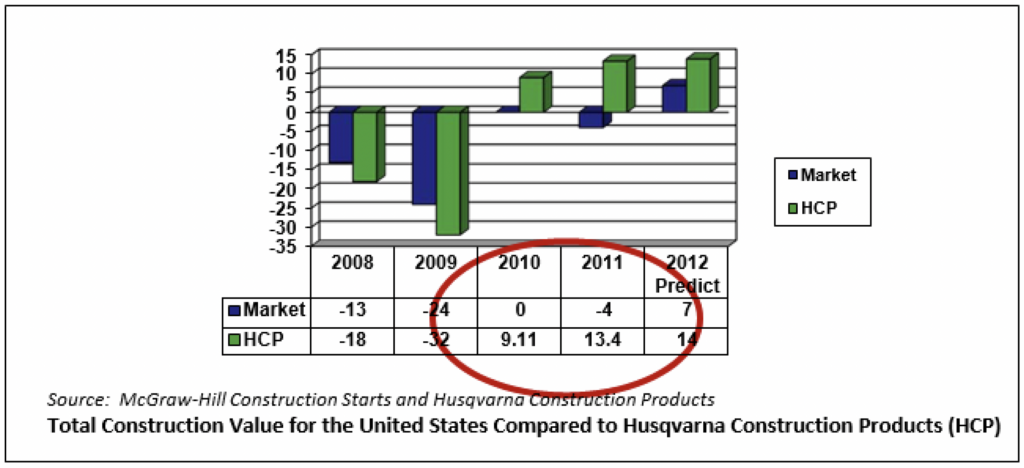
“The market was 13% down in 2008 and we were down more (18%),” Debbie said. “We knew we had problems. We also knew we had problems in 2009 – we were making all these changes and implementing new things. The market’s down 24% and we’re down 32%.”
“But, you know the interesting thing coming out of that year? We had a sales conference in January 2010 – just coming out of the 32% down – and I saw more energy, enthusiasm and spirit. And, believe it or not, it was noticed by our Swedish colleagues who came over in 2010,” she said. “And at the end of 2010, the market’s still flat and we’re up 9.11%. I think it has a direct correlation to everything we did.”
The good news continued into the first quarter of 2012: Husqvarna Construction Products sales were up 26 percent at the end of the first quarter, while the construction industry as a whole was still flat.
Husqvarna Construction Products sales were up 26 percent at the end of the first quarter, while the construction industry as a whole was still flat.
“In hiring, we got it right 88% of the time,” Debbie said. They hired 40 people between May of 2010 and Sept. 2011, of which 35 developed into successful contributors.
“That’s a really good return on investment for me to show when I’m talking to people in our organization who say: “What are you doing?” she said. “And much of it is what we’ve done with our partnership with Predictive Index and what we’ve done in our organization with all of the tools and processes we’ve put in place. “
“You get a place to work that is fun, you get engaged employees, you get enthusiasm, energy, team spirit –all of those things that come with going to a place where you really want to go and we are starting to see that,” Debbie said.
“We can walk around with our heads held high but we can’t get too cocky because the work is never done,” she said. “If we become complacent these things will start creeping back up. As a matter of fact we witnessed that a couple of months ago. We started to hear some water cooler talk and we started to hear some finger-pointing so we addressed it. The leadership of the company – and leader doesn’t come in title and tenure – has to push it out,” Debbie said. “We have to continually house-clean and we have to continually get rid of those ‘smells’ when they come up.”
“That’s a really good return on investment”
Debbie Slocum, Director of Human Resources
Discover the benefits of The Predictive Index
To learn how ADVISA can help transform YOUR organization, request a free consultation today.