
Your Reputation Starts Before You Realize It: 5 Things Recent Grads Should Know
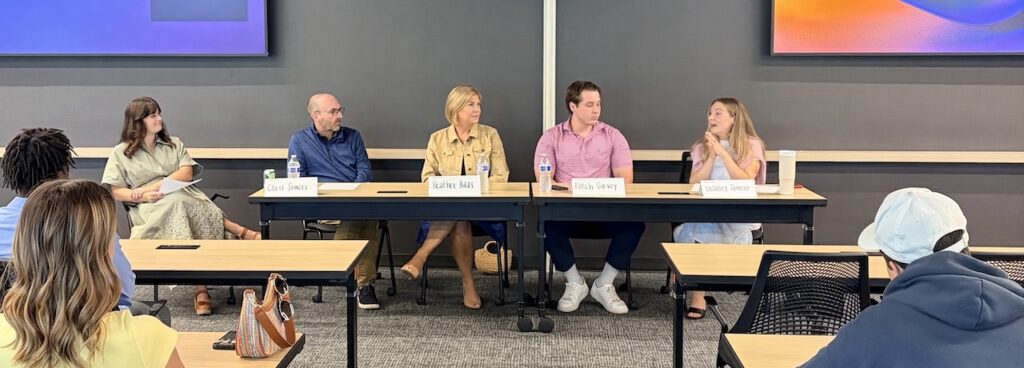
(Left to right) Chris, Heather, Patch, and I share insights with first-year Orr Fellows.
The transition from college to your first role can feel like a bigger leap than you expected.
It is rarely because the work itself is difficult, but because the rules fundamentally change and there is no syllabus to follow.
What replaces the syllabus is much quieter: people begin to form impressions of how you operate, and those observations get shared when you aren’t in the room. The great news is, the way you operate is within your control.
I recently had the honor of joining an Orr Fellowship panel representing four diverse points of view to talk through how reputations take shape, how they can easily be damaged, and why early habits matter much more than they seem at the time.
Here are five highlights from that panel:
1. Your reputation is written by other people, using their criteria
College gives you clear milestones, but professional environments usually do not. The information you need isn’t always offered on a schedule, and there is no clear way to measure what you’ve learned. People don’t wait to form impressions until you feel 100% confident in what you’re doing (wouldn’t that be great?). Here are two mindset shifts that will start you off on the right foot:
- Shift #1: Moving from consuming resources to seeking them. Try asking who owns a process, what a typical project looks like, and if you can shadow a few calls. Being proactive is often the first thing colleagues mention when asked what you are like to work with.
- Shift #2: Adapting to multi-generational teams. You will likely work alongside colleagues across several generations, each with their own view of professionalism.
You get to decide how you show up, but it helps to remember that your reputation is ultimately defined by others through their own lenses. Understanding how you are being perceived allows you to make informed decisions about how you operate.
2. Reputation is built in small moments now, and big moments later
Respect in a new role is built or lost in small everyday interactions rather than on high-stakes assignments.
These behaviors communicate “I am not reading the room”:
- Arriving late to scheduled meetings
- Dressing out of step with the environment
- Waiting for others to teach you
People judge your punctuality and presentation before they get to know your capabilities.
These behaviors communicate “I am watching and learning”:
- Show up on time, every time.
- Match the dress code of your workplace or meeting.
- Take initiative to shadow meetings and connect early on.
- Reach out for coffee meetings, and come with a few questions prepared.
- Follow through on small tasks, even if they aren’t explicitly in your job description.
Consistently doing what you said you would do builds a track record as someone reliable and attentive. That consistent experience is what forms your reputation in team discussions behind the scenes (which is where the big tasks are assigned!).
3. Asking thoughtful questions helps more than pretending to know everything
It is common for new professionals to view questions as a sign of weakness or incompetence. The truth is that nobody expects you to know everything, but they do expect you to own your learning.
In your first year, try to sandwich new actions, tasks or skills with questions:
Before you take action, ask for input.
It shows respect for your teammates’ experience, and it sounds like:
- How have we done this before?
- What will be important for me to keep in mind during XYZ task/meeting?
- How do you recommend approaching this?
After you take action, get feedback quickly.
Patch encourages showing up in-person to get fast, informal access to the people who can correct your work in two minutes instead of two days. It sounds like:
- How do you think that went?
- What would you do differently?
- What did you notice that I might have missed?
The real key is closing the loop: take the advice, apply it, and follow up with what happened. This shows your commitment to your own growth AND the team’s success.
4. Understanding how you work best accelerates your growth
Building a steady reputation requires consistent performance, which is much easier when your environment aligns with how you process information. Learning your behavioral tendencies gives you practical vocabulary to request conditions that help you succeed.
For instance, I shared that an early role felt overwhelming because it required all-day client meetings and quick verbal answers with no way for me to check my work. As someone who is detail-conscious and prefers time to process, the setup created unnecessary stress and felt like a personal shortcoming rather than an environmental mismatch.
Once I identified those working preferences, I made small adjustments to remove barriers:
- Asking for meeting agendas in advance to allow time to process
- Identifying knowledgeable peers to confirm details
- Structuring tasks so accuracy doesn’t feel rushed
Understanding your unique workplace motivations and needs allows you to advocate for yourself and fast-track your success.
5. Your network is how your reputation travels
While networking is common advice, it can feel awkward if it seems purely transactional.
It helps to realize how practical connections are: every panelist in our discussion joined ADVISA through a personal relationship or referral rather than a traditional job board posting.
The hardest step is often the initial outreach. Reaching out to someone new can feel uncomfortable, but most professionals are happy to connect if you make it easy. Here is a simple structure to try out in your next message:
- Connection and context – “I’ve been following your work on X”
- Request – “I’d love to grab 30 minutes of your time to ask a couple of targeted questions about X”
- Logistics – “Would any of these times work for a brief chat? I am flexible to your schedule.”
The step most often missed is tending to your network. Think of it like a garden, it needs consistent effort (and occasional weeding). Heather Haas and Chris Sowers have maintained a professional relationship for over 20 years by periodically checking in, not just reaching out when they need a favor. Treating professional relationships with regular care ensures that when opportunities arise, your network reflects genuine, established trust.
Key Takeaway
Your professional reputation builds gradually from simple daily habits: meeting commitments, following up promptly, applying feedback, and staying in touch with colleagues over time.
Taking ownership of those small details helps build trust naturally, making your transition into new roles and opportunities far smoother.
Meet the Panelists

Heather Haas
Heather believes everyone deserves the opportunity to thrive at work. As CEO of ADVISA, Heather brings vision and passion to creating a magnetic work culture where the best and brightest people choose to work. She loves building and working alongside the members of the A-Team to help clients create competitive advantage and achieve results through their people. Learn more about Heather.

Delaney Spencer
Delaney graduated from DePauw University with a bachelor’s degree in psychology. She spent most of her time after college as a consultant for a global tech company, developing critical thinking and solution-building skills to help HR teams succeed in rolling out new software systems. Learn more about Delaney.

Chris Sowers
Chris believes that for many of us, our jobs don’t just have to be a way to earn a paycheck. Rather, through a combination of meaningful work and empowering leadership, our jobs can actually help us self-actualize. He experienced that early in his career and has tried to foster environments where others can thrive ever since. Learn more about Chris.

Patrick Garvey
Patrick — better known as “Patch” — is all about sparking those initial conversations that get people thinking differently about their workplace. He brings a high-energy, human approach to outreach, focusing on building sincere connections with leaders who are ready to truly invest in their people. Learn more about Patch.
About Orr Fellowship
Orr Fellowship is on a mission to create the premier post-undergraduate experience in the nation. Made up of a community of recent college graduates with varied interests and backgrounds, Orr Fellows pursue their first full-time career while living in Indianapolis.
ADVISA is a proud partner and training provider to Orr Fellowship.
Fun fact: ADVISA’s own Sarah Kolczak was a 2021 Orr Fellow.
RELATED READING
Gen Z Is Ushering in the New Workplace Norms We All Want by Catherine Mazanek of Orr Fellowship